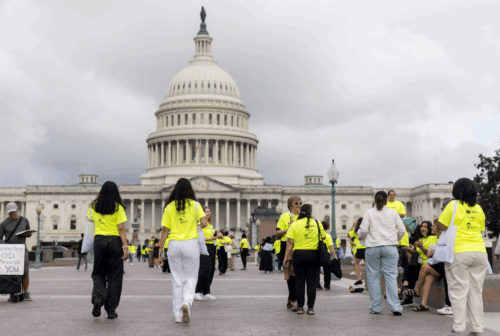
WASHINGTON, D.C. – As states gear up for the 2026 midterm elections, a new report from Intersections of Our Lives and Ipsos unveils the most up-to-date priorities, concerns, and most salient voting issues and motivators for Black, Hispanic, and Asian American and Native Hawaiian and Pacific Islander (AANHPI) women.
The report reveals that a staggering 89 percent of women of color are concerned they can’t afford their family’s basic needs — while only 40 percent believe their voice matters in the political process. For the majority of women of color, the “American Dream” feels out of reach — even as they represent a crucial voting bloc in the upcoming midterm elections.
Across the United States, women of color are suffering the deadly consequences of restrictive abortion laws, aggressive anti-immigrant policies, rising discrimination and increased barriers to accessing life-saving health care. All the while, their voices are being silenced through efforts to thwart their participation in the democratic process.
Key findings from the report include:
- 250 years ago, America was founded on the idea of the “American Dream” — a dream in which anything was possible if you worked hard enough. For the majority of women of color, the “American Dream” is no longer attainable.
- More than a third (36%) say their family finances have worsened over the past year, with one in four (24%) saying their financial situation is tight and requires them to carefully watch their spending.
- One in five (21%) say they are covering their expenses with little left over, and around one in eight (13%) say they are struggling to make ends meet.
- So women of color set their sights on a new dream — one focused on reproductive justice and the freedom to choose how to live their lives. When women are given choice and autonomy over their futures, they say their lives improve.
- The vast majority of respondents agreed that when they are able to plan when to have children, it helps them succeed in their careers.
- 62% agreed that women’s financial stability improves when they can make their own reproductive choices.
- Meanwhile, few women of color think the government is doing a good job of supporting their ability to choose if and when to have children.
- Just 15% rate the government as doing a good job of providing access to reproductive health care.
- Around one in 10 (12%) say the government is doing a good job of making it possible to afford to raise children.
- But right now, there is one concern that supersedes all others amongst women of color: skyrocketing costs. Across the board, women of color feel as though they cannot afford basic everyday essentials, from groceries to gas to child care to housing.
- The majority (89%) are concerned about affordability and the cost of living.
- Nearly two in three (64%) have delayed major life decisions, including nearly a quarter (23%) who have put off buying a home and around one in five (21%) who have delayed getting health care.
“AAPI women are paying close attention to leaders who are addressing the realities our communities are navigating every day. This report highlights that it is not enough to talk about rights in theory — care needs to be affordable, culturally and linguistically accessible, and within reach for AAPI women to have real agency over our lives and futures. Across our communities, intersectional barriers like cost, immigration status, language access, and systemic inequities continue to stand in the way, and addressing them must be part of any real solution,” said Christina Baal-Owens, Executive Director of the National Asian Pacific American Women’s Forum.
“Black women know that Reproductive Justice means having the freedom, resources, and power to care for our families, make ends meet, and plan our futures with dignity. This research makes clear that rising costs and barriers to health care are limiting that freedom in real, immediate, and sometimes life-threatening ways. With midterm elections fast approaching, policymakers and candidates cannot afford to overlook Black women voters — they must address the full scope of our lived realities and invest in solutions that allow our communities to thrive,” said Dr. Regina Davis Moss, President and CEO of In Our Own Voice: National Black Women’s Reproductive Justice Agenda.
“As we head into a critical election year, Latine voters are motivated and ready to participate, and we expect candidates to invest in the issues that matter most to us. Our communities are concerned about the rising cost of living, their ability to get the health care they need, and make decisions about their lives. This polling reinforces that it’s not enough for care to be legal — it must be affordable, accessible, and actually within reach for our communities who are navigating these challenges every day,” said Lupe M. Rodríguez, Executive Director of the National Latina Institute for Reproductive Justice.
The multi-phased research project, titled Amplifying Women of Color Voices, was conducted in the fourth quarter of 2025. The qualitative phase of the research engaged 72 women of color voters from six key states — Arizona, California, Georgia, Nevada, New Jersey, and Texas — on topics related to economic anxiety, civic engagement and reproductive health. From one-day online journals to multiple virtual interviews, the insights of this timely research offer a deeper look into the lives, lived experiences, and perspectives of women of color on voting issues and politics.
For the quantitative component, the Ipsos research team surveyed a nationally representative sample of 1,017 women of color across three segments — Black, Hispanic, and AANHPI — with an opt-in oversample of 1,475 women in the six key states, which were selected for their demographic significance and relevance to policy priorities. The survey was conducted December 5 to December 16, 2025, using Ipsos’ KnowledgePanel®, a probability-based online panel designed to be representative of the U.S. population. Findings above reflect the nationally representative, KnowledgePanel portion of the study only. The margin of sampling error is plus or minus 3.49 percentage points at the 95% confidence level for results based on the KnowledgePanel®.